


Law firms are moving beyond GenAI pilots and into practical adoption across drafting, research, contract review, and internal communications. Here’s what CIOs and partners need to know about ROI, governance, tool sprawl, and building a sustainable AI strategy.

After 24 months of cautious GenAI experimentation, law firms are now at a crossroads: aggressively pursue disruption or continue scaling cautiously. Along the way, CIOs and partners must decide which tools to adopt, how to manage workforce impact, and how to protect client confidentiality.
Here at eGroup, we’ve seen a ~10x increase in legal firms adopting Copilot in the past 6 months. We recently held a panel discussion with practitioners involved with such engagements, and an external attorney (and GenAI power user). The legal professionals and IT executives in attendance provided their inputs via polls. This blog post summarizes that content, providing the state of the union on GenAI adoption in the legal profession.
The Verdict Is In: Some law firms are moving beyond pilots to use AI as an integral part of legal operations.
GenAI Adoption Trends in Law Firms
Rapid AI Adoption
The past year has seen a rapid uptake of GenAI tools across the legal sector. Panelist Bergin Fisniku, an attorney and principal at Elliott Davis, observed, “What I’m observing is very quick adoption amongst our people.” Seven months ago, his firm rolled out a purpose-built AI tool as well as Microsoft 365 Copilot, reporting impressive results after a cautious 12-week pilot.
“The acceleration of research has been a game changer. Typically, a three-hour research project can be condensed into 30 to 60 minutes at most with effective use.”
This enthusiasm echoes broader industry trends, where law firms are moving past simple meeting summaries and integrating GenAI into contracts, briefs, and research workflows.


Intentional AI Enablement
Hayley Meese-Cherry, eGroup’s Copilot UX specialist and change management leader, stressed the importance of intentional adoption: “We’ve come across organizations that turned it on, let people know, hey, it’s out there, and just sort of left it at that.”
Instead, she advocates for top-down commitment and structured training, noting that:
“The point of it is being intentional, letting everyone know from the top down that this is a journey that you’re investing in.”
Sustainable adoption comes from building communities around AI, sharing best practices, and planning for ongoing support.
ROI and Governance at Scale
Tom Papahronis, one of eGroup’s Strategic Advisors, highlighted the hidden benefits of GenAI:
“ROI can be pretty quiet. It’s 10 minutes here, it’s 15 minutes there… Don’t discount that over a week. That’s going to save somebody 6 hours.”
He also emphasized that data security and governance are evolving, requiring new processes and collaboration between IT and legal teams.
Common GenAI Use Cases in Law Firms
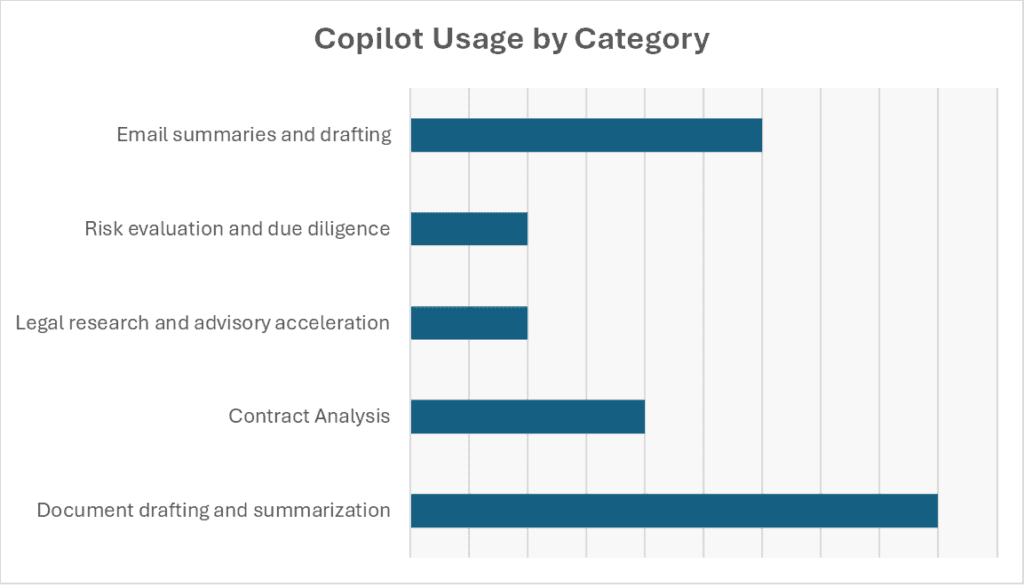
The audience was polled on their current use cases. Commentary on the audience’s input follows the chart.
Document-Centric Adoption Dominates
An overwhelming 90% of respondents are leveraging Copilot for document drafting and summarization. This signals that AI is becoming essential for core legal work product creation and review.
Email Efficiency Made Easy
With 60% of respondents, email summaries and drafting represent the second-highest use case, reflecting the demand for streamlining high-volume legal communications.
Contract Analysis Gaining Traction
40% of respondents use Copilot for contract analysis, indicating growing trust in AI for substantive legal review tasks that require significant attorney time. Copilot can, for instance, take a redlined contract, compare it to the original, and create a table outlining the risks of accepting the changes and offering counters.
Advanced Use Cases Are Emerging
While legal research/advisory acceleration and risk evaluation/due diligence are each only adopted by ~20% of the audience, these represent high-value, complex applications that may see growth as user confidence increases.

Key Challenges in Scaling GenAI
Reducing Cost Waste, and Tech Debt
Operationalizing AI means treating it as a capability investment, not just another license. Hayley explained:
“Firms that are really seeing the most value are treating AI like a capability investment, not just another tool.”
Surveying users should be done before and after training, and it usually reveals time savings, often 10 to 15% in just a week. Firms see faster turnaround, more capacity per attorney, and better client responsiveness. ROI will ramp up further when AI is enabled for all involved with entire legal processes, not just steps.
Managing Agent and Tool Sprawl
As firms integrate AI across document management systems, SharePoint, and third-party platforms, tool sprawl and version control challenges can arise.
Tom warned, “It’s really important not to make the assumption that just because you can get some kind of a result out of one third-party connection or agent, that you’re going to get an equivalent result out of another.”
Standardizing enterprise solutions like Microsoft Copilot, with built-in data protections, helps reduce fragmentation and risk.


Key Takeaways from Panelists
- Bergin: “I’ve been speaking to some people on my team who understand that part of their annual review will have an expectation that they’re going to be using our AI tools more. We get so much ROI from it, our margins get a whole lot better, and frankly, our clients are starting to expect it.”
- Tom: “Don’t forget all the lessons you learned doing everything else that you do. Everybody gets a little bit myopic on AI. If you look at your information security program, draw lessons from that.”
- Hayley: “Plan for short and long-term resources. How are you going to roll this out effectively, instead of just a tool for the sake of having a tool? Then after that’s done, you now plan for what you’re going to do to keep it going.”
Actionable Recommendations for CIOs and Partners
- Design a roadmap to standardize GenAI across workflows.
- Understand your build/buy decisions. The panelists spent time discussing the options of buying AI add-ons to Document Management Systems and/or connecting such sources of truth to Copilot via a standard API.
- Survey your teams before and after AI adoption to measure real ROI and identify champions. This will help effectively justify the next round of investments.
- Prioritize data security and governance. Use enterprise platforms with robust controls, like Purview, SharePoint Advanced Management, and Agent 365.
- Reduce tool sprawl by consolidating on scalable, integrated solutions.
- Invest in ongoing training and build communities of practice to sustain adoption.


Conclusion
As attorney and principal, Bergin said:
“The legal industry, with the assistance of AI, could have a renaissance. I really do believe that.”
Now is the moment for CIOs and law firm partners to move decisively, invest in their people, and build a sustainable foundation for their AI-powered legal practice.
Accelerate AI Adoption Across Your Legal Practice
From roadmap to rollout, eGroup helps law firms standardize GenAI, reduce tool sprawl, and enable secure, high-impact Copilot usage across legal teams.